Austin Metro Area Real Estate News & Market Trends

We built our blog to be your go-to resource for life in Austin, TX. From deep dives into local market statistics and home values to the latest community happenings around town, we cover it all. We’re invested in this community and truly want to help you find your place in it. If you have any questions about the Austin area, please reach out—we’d love to chat!

Feb. 19, 2026

Cedar Park vs Leander vs Pflugerville: Austin Suburb Showdown


The decision between Cedar Park, Leander, and Pflugerville often comes down to budget, commute priorities, and recreational preferences. These three rapidly growing communities in Williamson County and Travis County each bring unique advantages to homebuyers exploring Austin's northern corridor.

Price Points and Housing Stock

Cedar Park's median home price sits around $465,000, reflecting its mature development and prime location near Lake Travis. Popular zip codes like 78613 and 78641 offer everything from homes under $400k to luxury properties with pools and 3-car garages. Leander presents more affordable options with a median around $420,000, featuring significant new construction activity and larger lots in developments along the 183A corridor. Pflugerville offers the most competitive pricing at approximately $395,000 median, with strong value in 78660 and 78660, making it particularly attractive for first-time buyers seeking homes between $200-$400k.

Commute Dynamics and Transportation Access

Pflugerville claims the shortest commute to Austin's tech employers, positioned just 20-25 minutes from downtown via I-35 or Highway 130 toll road. Its eastern location provides quick access to Samsung, Dell, and the Domain area. Cedar Park offers multiple route options including Highway 183, the 183A toll road, and Parmer Lane, averaging 25-35 minutes depending on destination. The city's central position between I-35 and Highway 620 creates flexibility. Leander sits furthest northwest at 35-45 minutes, though the Capital MetroRail Red Line provides commuter rail service to downtown Austin, offering an alternative to sitting in traffic for those working in the central business district.

Recreational Amenities and Lifestyle

Cedar Park delivers premium access to outdoor recreation through Brushy Creek Regional Trail, multiple parks, and proximity to Lake Travis via Lago Vista and Jonestown. The H-E-B Center at Cedar Park hosts professional hockey and major concerts. Leander's newer developments feature resort-style amenities, and the city provides easy access to Hill Country attractions along Highway 29 toward Burnet and Marble Falls. Pflugerville's Lake Pflugerville offers swimming, fishing, and trail access, while the city's Pfluger Park and extensive greenway system create strong connectivity throughout established neighborhoods.

School Districts and Education

Leander ISD serves both Cedar Park and Leander, consistently ranking among Texas's top-rated large school districts with excellent fine arts and athletics programs. Pflugerville ISD serves most of Pflugerville, offering strong academics and newer facilities reflecting the district's recent growth. Portions of Cedar Park also fall within Round Rock ISD, adding another highly-regarded option for education-focused buyers.

Market Momentum and Future Growth

All three markets show robust appreciation trends, with Pflugerville experiencing the fastest growth due to its affordability and tech corridor access. Cedar Park's established amenities and strong school reputation maintain steady demand despite higher price points. Leander represents the growth frontier, with substantial infrastructure investment and development activity along the 183A toll road corridor promising continued expansion.


Whether seeking established amenities in Cedar Park, growth opportunity in Leander, or value and convenience in Pflugerville, each community offers distinct advantages for Austin-area homebuyers. Visit AustinBestAgent.com to explore current listings and receive personalized guidance on these dynamic markets.

Feb. 19, 2026

Round Rock vs Georgetown vs Liberty Hill: Which Austin Suburb Fits Your Lifestyle?


Choosing between Round Rock, Georgetown, and Liberty Hill involves weighing commute convenience against budget, lifestyle preferences, and long-term investment potential. These three Williamson County communities each offer distinct advantages for those seeking a home north of Austin.

Home Prices and Affordability

Round Rock's median home price hovers around $425,000, reflecting its established infrastructure and proximity to major employers like Dell, Amazon, and Samsung. The city offers diverse housing options from homes under $400k to luxury properties in master-planned communities. Georgetown presents a similar price point with median values near $440,000, with particular strength in 78628 and 78633 zip codes. Liberty Hill stands out as the most budget-friendly option, with median prices around $380,000, making it attractive for those seeking homes with acreage or new construction at lower price points.

Commute and Location Considerations

Round Rock delivers the shortest commute to Austin's tech corridor, approximately 25-30 minutes to downtown Austin via I-35 or toll roads. Georgetown sits 30-40 minutes north, though traffic on I-35 can extend travel times during peak hours. Liberty Hill requires the longest commute at 40-50 minutes, primarily via Highway 29 and the 183A toll road, making it better suited for those who work remotely or have flexible schedules. Round Rock's position offers quickest access to Austin-Bergstrom International Airport, while Georgetown provides easier access to Lake Georgetown and the northern Hill Country.

Lifestyle and Community Character

Round Rock combines suburban convenience with small-town charm, featuring the historic downtown district, the Dell Diamond minor league baseball stadium, and extensive retail along I-35. The Round Rock ISD serves most of the city with highly-rated schools. Georgetown's Victorian-era downtown square serves as the community's heart, surrounded by locally-owned shops and restaurants. The city's proximity to Lake Georgetown provides abundant recreational opportunities, and Georgetown ISD consistently earns strong ratings. Liberty Hill maintains a more rural atmosphere with larger lot sizes, less traffic congestion, and a quieter pace of life. The Liberty Hill ISD serves the area, and residents enjoy close-knit community events throughout the year.

Investment and Growth Outlook

All three markets demonstrate strong appreciation potential, though for different reasons. Round Rock's established corporate presence provides economic stability, while Georgetown's balanced growth between retiree communities and young professionals creates sustained demand. Liberty Hill represents the frontier of Austin's northern expansion, with significant infrastructure improvements planned along the 183A corridor. Property tax rates in Williamson County are comparable across all three cities, though specific rates vary by school district and municipal utility districts.

Whether prioritizing convenience in Round Rock, heritage and recreation in Georgetown, or space and value in Liberty Hill, understanding these distinctions helps buyers make informed decisions aligned with their lifestyle priorities. Contact Texas Pride Realty Group for detailed market insights and available properties in these thriving Austin-area communities.

Feb. 19, 2026

Is It a Buyer's or Seller's Market in Austin, TX?

Understanding whether you're entering a buyer's or seller's market fundamentally shapes your real estate strategy. As a 23-year veteran real estate agent with over 1150 transactions, I'm going to break down what the Austin TX real estate 2026 landscape looks like and what it means for your specific situation.

Defining Buyer's vs. Seller's Markets

Let's start with basics. A seller's market occurs when demand exceeds supply—more buyers than available homes. This creates competition, bidding wars, quick sales, and upward price pressure. Think Austin 2021-2022 when homes sold in days with multiple offers over asking price.

A buyer's market exists when supply exceeds demand—more homes than qualified buyers. This gives buyers negotiating leverage, longer marketing times, price reductions, and seller concessions. We haven't truly experienced this in Austin for many years.

Then there's the balanced market—where supply and demand reach equilibrium. Homes sell at reasonable pace, prices remain stable, and neither party holds overwhelming leverage. This is closer to what we're experiencing in Austin's 2026 market, though with variations across price points and locations.

Current Austin Market Indicators

Several metrics help us determine market conditions. As a Broker Associate at HomeSmart Stars - Texas Pride Realty Group, I track these indicators daily to advise clients accurately.

Inventory Levels: The Austin metro currently maintains approximately 5.9 months of housing inventory. Traditionally, 6 months represents a balanced market—less favors sellers, more favors buyers. We're essentially at equilibrium, though this varies significantly by area and price range.

Round Rock homes for sale might carry 4.5 months inventory while Georgetown holds 6.5 months—same metro area, different dynamics.

Days on Market: Homes across the Austin metro average 68-77 days on market as of early 2026, compared to just 30-45 days during peak seller's market conditions. This increased marketing time indicates reduced competition and more measured buyer behavior.

Properties in high-demand areas like Lakeway or premier Lake Travis ISD neighborhoods still move faster—often 40-60 days. Meanwhile, homes in outer suburbs like Liberty Hill or Hutto might take 75-90+ days.

Price Trends: The Austin metro has seen modest 1.3% year-over-year price appreciation—a dramatic shift from the 20-30%+ annual gains of 2021-2022. Some neighborhoods have actually experienced slight price decreases, particularly in the luxury segment above $800,000.

Home values in Austin TX remain significantly elevated compared to pre-pandemic levels (2019), but the speculative frenzy has clearly subsided. This moderate appreciation signals market normalization rather than continued overheating.

Sale Price to List Price Ratios: Across the metro, homes are selling at approximately 94-97% of listing price. During peak seller's market conditions, homes routinely sold at 100-105%+ of list price. This metric clearly shows reduced competition and increased buyer negotiating power.

Market Conditions by Price Range

The Austin market isn't monolithic—conditions vary dramatically by price point.

Under $300,000: Still relatively competitive, especially in outer suburbs like Kyle, Pflugerville, and San Marcos. First-time buyers and investors compete for these entry-level properties, creating seller-favorable conditions with multiple offers still common.

$300,000-$500,000: The sweet spot of Austin TX homes for sale. This range sees balanced market conditions with reasonable competition but room for negotiation. Properties in Cedar Park, Leander, and Round Rock dominate this segment.

$500,000-$800,000: Slightly buyer-favorable, particularly in suburban markets. Well-presented homes still sell, but buyers have leverage to negotiate repairs, closing cost assistance, and sometimes price reductions. Areas like parts of Georgetown and Bee Cave fit here.

$800,000+: Definitively a buyer's market. Luxury inventory has expanded, days on market are extended (often 90-120+ days), and price reductions are common. Properties in Westlake Hills or luxury Lakeway estates require strategic pricing and marketing.

Geographic Variations Matter

Bob McCranie real estate clients learn quickly that location dramatically impacts market dynamics within the metro area.

Travis County: Generally more balanced to slightly seller-favorable, especially in desirable Austin zip codes like 78704, 78702, and 78745. Limited land availability constrains supply.

Williamson County: More buyer-favorable overall due to extensive new construction in Cedar Park, Leander, and Georgetown. Builders compete with resale inventory, creating opportunities for buyers.

Hays County: Balanced to slightly buyer-favorable. Rapid development in Kyle and Buda has increased inventory, while continued job growth maintains demand.

Outer Counties: Bastrop County, Burnet County, and Caldwell County lean buyer-favorable with longer commutes and more available land.

What This Means for Buyers

If you're shopping for Austin TX homes for sale in 2026, conditions are more favorable than we've seen since 2019. My 45 Google 5-star reviews include buyers who appreciated that I helped them leverage current conditions to negotiate effectively.

You can: Request inspections and actually use findings to negotiate repairs or credits. Take time making decisions without pressure. Submit offers with reasonable contingencies. Negotiate seller contributions toward closing costs or rate buydowns. Walk away if terms don't work without fear of missing your only chance.

You should still: Get pre-approved before house hunting. Work with an experienced agent who knows the local market nuances. Act decisively when you find the right property. Understand that well-priced homes in desirable areas still move quickly.

One recent client told me, "Bob helped us understand that even though it's more of a buyer's market, we still needed to be prepared and move quickly on the right property. We got our Cedar Park home at a fair price with $10,000 in seller concessions—best of both worlds."

What This Means for Sellers

Selling in 2026 requires more strategy than during peak conditions. After over 1150 transactions, I've developed proven systems that position properties competitively regardless of market conditions.

You need to: Price correctly from day one using comprehensive market analysis. Present your home impeccably—staging, repairs, professional photography matter immensely. Be prepared to negotiate on price, repairs, and potentially closing cost assistance. Understand your property will likely be on market 60-90 days rather than 15-30 days. Work with an agent who has proven marketing systems and negotiation expertise.

You can still: Achieve excellent results with proper preparation and pricing. Attract multiple offers if your property stands out. Sell on reasonable timelines in most areas. Build in your desired terms and negotiation room into initial pricing.

The Texas Pride Realty Group approach focuses on strategic positioning—pricing based on recent comparable sales, extensive marketing across digital and traditional channels, and skilled negotiation that protects your interests while keeping transactions moving forward.

The Bigger Picture: Austin's Long-Term Outlook

Regardless of short-term market classifications, Austin's long-term fundamentals remain strong. Population growth continues (though moderated from pandemic peaks), major employers maintain significant operations, and quality of life factors ensure continued demand.

For buyers, current conditions offer opportunities to enter the market with less competition and more negotiating power than we've seen in years. For sellers, success requires adapting to new realities rather than expecting pandemic-era results.

As a Broker Associate at HomeSmart Stars - Texas Pride Realty Group with 23 years of experience navigating multiple market cycles, I help clients understand not just what the market is doing, but what it means for their specific situation and goals.

Whether you're exploring new construction in Hutto, established neighborhoods in Round Rock, or lakefront properties, understanding current market dynamics helps you make informed, strategic decisions.

So is it a buyer's or seller's market in Austin? The answer is: it's a strategic market. Those who understand conditions, price appropriately, and work with experienced professionals will succeed regardless of which side of the transaction they're on.

Contact Bob McCranie at HomeSmart Stars - Texas Pride Realty Group | 972-754-0582 | www.TexasPrideRealty.com for a FREE 2026 Market Strategy Session


Feb. 19, 2026

Should I Buy Now or Wait in the Austin Market?

This is the question I hear most often from prospective buyers exploring Austin TX real estate 2026 opportunities. After selling over 1150 homes as a Broker Associate at HomeSmart Stars - Texas Pride Realty Group, I understand the anxiety behind this decision. Nobody wants to buy at the "wrong time." Let me walk you through the factors that should guide your decision.

The Timing Question Nobody Can Answer Perfectly

Here's the truth that some agents won't tell you: nobody can predict the future with certainty. Not me, not economists, not real estate gurus on social media. What I can do after 23 years in this business is help you analyze the current conditions, understand the risks and opportunities, and make the decision that's right for your specific situation.

The "perfect time" to buy is a myth. There are only good times and better times, and they're different for everyone based on personal circumstances, financial position, and long-term goals.

What the Current Market Tells Us

The Austin market in early 2026 looks fundamentally different from the feeding frenzy of 2021-2022. We've seen meaningful corrections from peak pricing, inventory has expanded to healthy levels (5.9 months supply), and homes are staying on the market long enough for proper due diligence.

Home values in Austin TX have stabilized with modest year-over-year increases around 1.3% across the metro area. This isn't the explosive appreciation of recent years, but it's also not a crash. Properties in desirable areas like Round Rock, Georgetown, and Lakeway continue showing steady demand.

Median prices have come down from pandemic peaks: the Austin metro median sits around $444,490, while the city of Austin proper averages $590,000. Importantly, these prices are still significantly higher than 2019 levels, meaning the market has retained much of its pandemic-era gains while shedding the most speculative excesses.

The Interest Rate Reality

Mortgage rates hover in the 6-7% range as of early 2026. Yes, this is dramatically higher than the 2.5-3.5% rates available during 2020-2021. However, here's what Bob McCranie real estate clients need to understand: those historic low rates drove bidding wars and inflated prices. You paid 3% interest but often paid 10-20% over asking price with waived contingencies.

Today's environment offers something valuable: negotiating power. Buyers can request inspections, negotiate repairs, ask for seller concessions toward closing costs, and take time making decisions. One of my recent clients shared, "We got $12,000 in seller credits and a $8,000 price reduction on our Cedar Park home. That would have been impossible two years ago, even with lower rates."

Additionally, you can refinance your mortgage rate later if rates drop. You cannot renegotiate the purchase price after closing. As the saying goes: "Marry the house, date the rate."

The Affordability Calculation

Real affordability isn't just about interest rates—it's about the total monthly payment including principal, interest, insurance, taxes, and HOA fees. Texas Pride Realty Group clients benefit from my comprehensive affordability analysis that accounts for all these factors.

Texas property taxes significantly impact monthly costs. In Travis County, expect effective rates around 1.8-2.1%. Williamson County runs slightly lower. A $400,000 home might carry $7,000-$8,400 in annual property taxes—that's $580-$700 per month before considering principal and interest.

Insurance costs have also risen, particularly in areas prone to hail damage. Budget $1,500-$3,000+ annually depending on home value and coverage. These "hidden" costs often surprise first-time buyers who focus solely on the mortgage payment.

The good news? With expanded inventory and balanced market conditions, you're more likely to find homes priced appropriately with room for negotiation on both price and terms.

Life Circumstances Trump Market Timing

As a 23-year veteran real estate agent, I've learned that personal circumstances should drive your decision more than market conditions. Consider these questions:

Is your current housing situation stable? If you're renting month-to-month or facing lease renewal with significant increases, buying now may provide housing cost certainty even if rates are elevated.

Has your income situation improved? Job stability, raises, or dual-income households change affordability calculations dramatically. If you can comfortably afford payments, market timing becomes less critical.

Are you planning to stay put? Real estate historically appreciates over 5-10+ year periods regardless of short-term fluctuations. If you're planning to stay in the Austin area for at least five years, current market timing matters less than finding the right property.

Do you have a strong down payment saved? Larger down payments (15-20%+) reduce monthly costs and increase approval odds. If you've reached this milestone, delaying might mean watching your down payment lose purchasing power to inflation.

The Cost of Waiting

What does waiting cost? If Austin home prices appreciate even 2-3% annually (below historic averages), that $400,000 home becomes $408,000-$412,000 next year. Your down payment needs increase accordingly. Meanwhile, you're paying rent that builds zero equity.

I recently helped a client who had been "waiting for the perfect time" since 2019. She calculated that her rent payments over four years totaled $72,000—money that could have been building equity in a home that likely appreciated $80,000-$120,000 over that period. Her delay cost her over $150,000 in wealth building.

Areas like Pflugerville, Leander, and Kyle offer particularly strong value right now with room for long-term appreciation as Austin's growth continues.

The Benefits of Acting Now

With my 45 Google 5-star reviews, clients consistently mention that I helped them see opportunities others missed. The 2026 market offers several distinct advantages:

Negotiating leverage: Sellers are realistic about pricing and willing to contribute toward closing costs or make repairs.

Time for due diligence: You can conduct thorough inspections, research neighborhoods, and make informed decisions without pressure.

Inventory selection: More homes on the market mean better chances of finding properties that meet your specific criteria.

Less competition: Multiple offer situations have decreased significantly, giving qualified buyers room to negotiate.

Making Your Decision

Should you buy now or wait in the Austin market? Here's my professional assessment after over 1150 transactions:

Buy now if: You have stable income, solid down payment, plan to stay 5+ years, and found a property you love in an area you want to live. Current conditions favor patient buyers who do their homework.

Consider waiting if: You're uncertain about job stability, lack adequate down payment, might relocate within 2-3 years, or haven't found properties that meet your needs. Don't buy out of fear of missing out.

Avoid waiting if: You're trying to time the "bottom" or waiting for rates to drop to pandemic levels. These scenarios may never materialize, and you'll miss building equity while you wait.

For buyers looking at areas like Hutto, Buda, or Liberty Hill, current prices represent strong value with significant long-term potential as Austin's growth continues.

The question isn't really "should I buy now or wait?"—it's "am I ready to buy, and do current conditions support my goals?" As a Broker Associate at HomeSmart Stars - Texas Pride Realty Group, I help clients answer these questions based on their unique situations, not generic market predictions.

Contact Bob McCranie at HomeSmart Stars - Texas Pride Realty Group | 972-754-0582 | www.TexasPrideRealty.com for a FREE 2026 Market Strategy Session


Feb. 19, 2026

What Are the Best Neighborhoods in Austin, TX for 2026?

Choosing where to live in the Austin area is just as important as choosing the right home. After 23 years as a Broker Associate at HomeSmart Stars - Texas Pride Realty Group and selling over 1150 homes, I've helped people find their perfect neighborhood match across every corner of this region. Let me share what makes each area special and help you narrow down your search.

Understanding Austin's Neighborhood Landscape

The greater Austin area encompasses far more than just the city limits. We're talking about Travis, Williamson, Hays, Bastrop, and Caldwell counties—each offering distinct communities with unique characteristics. The "best" neighborhood depends entirely on your priorities: commute time, school quality, entertainment access, acreage, or affordability.

What I love about Austin TX real estate 2026 is the incredible variety. You can find everything from urban high-rise condos to 10-acre ranch properties, historic bungalows to brand-new smart homes. The key is matching the neighborhood's lifestyle to your personal preferences.

Central Austin: Urban Living at Its Finest

Central Austin neighborhoods like 78704, 78703, and 78702 offer the quintessential Austin experience. These areas put you walking distance from restaurants, music venues, and Lady Bird Lake trails. Properties here command premium prices—often $600,000-$1,500,000+ depending on size and condition.

I recently worked with a client who was relocating from San Francisco. She told me, "Bob helped me understand that while these neighborhoods are expensive, the walkability and culture made them worth every penny for my lifestyle." These central zip codes see high demand and limited inventory, making them competitive even in the more balanced 2026 market.

For those seeking central Austin character at slightly lower price points, consider 78722 or 78723. These East Austin neighborhoods have seen tremendous development while maintaining neighborhood charm.

North Austin: Value and Convenience

North Austin provides excellent value propositions with convenient highway access. Areas like 78759, 78758, and 78753 offer diverse housing stock at moderate price points—typically $350,000-$550,000.

These neighborhoods appeal to buyers who want to be "in Austin" without downtown price tags. You'll find good schools, parks, shopping, and easy access to major employers in the Domain area and beyond.

South Austin: Keep It Weird

South Austin neighborhoods maintain the area's bohemian character while offering tremendous variety. From 78745 near Southpark Meadows to 78748 in the Southwest, these areas provide solid value and strong community vibes.

Circle C and Avery Ranch neighborhoods in 78739 and surrounding areas offer planned communities with amenities, pools, and highly-rated schools. These are popular with buyers seeking suburban convenience while remaining within Austin city limits.

West Austin: Luxury and Lakeside Living

West Austin encompasses some of the region's most desirable and expensive real estate. Westlake Hills, Tarrytown (78703), and Rollingwood feature stunning properties, top-rated Eanes ISD schools, and proximity to downtown.

Lakeway offers resort-style living with Lake Travis access, golf courses, and a strong sense of community. Properties here range from $400,000 condos to multi-million dollar waterfront estates. As Bob McCranie real estate clients often discover, the Lake Travis area provides exceptional quality of life with both waterfront and hill country views.

Williamson County Suburbs: Growth and Quality Schools

Williamson County dominates discussions about the best suburbs in the Austin metro. Round Rock combines excellent schools, major employers (Dell, Amazon), entertainment (Dell Diamond), and reasonable prices. Most homes fall in the $300,000-$500,000 range with diverse options from starter homes to executive properties.

Georgetown appeals to those seeking small-town charm, historic downtown square, and lake access via Lake Georgetown. The community maintains its identity while growing rapidly. Home prices typically range $275,000-$650,000.

Cedar Park and Leander continue attracting buyers seeking new construction, excellent schools, and master-planned communities. These cities offer the best balance of affordability and growth potential in 2026.

Pflugerville provides some of the region's best value, with median prices around $350,000-$425,000. The community maintains strong schools, parks, and a genuine neighborhood feel.

Hutto and Liberty Hill represent the outer ring where new construction dominates and buyers can still find homes under $350,000.

Hays County: Balance of Affordability and Austin Access

Kyle and Buda have exploded in popularity as affordable alternatives with improving infrastructure. Kyle offers particularly good value in the $300,000-$450,000 range with new developments throughout.

San Marcos provides even more affordability with the added benefit of Texas State University's college town energy and the beautiful San Marcos River. Properties here often run $250,000-$400,000.

Hill Country Living: Space and Scenery

For buyers prioritizing acreage and scenery, Dripping Springs, Wimberley, and Marble Falls deliver authentic Texas Hill Country living. Expect longer commutes but spectacular settings, often with properties on 2-20+ acres.

Matching Neighborhoods to Your Priorities

Through my 45 Google 5-star reviews and over 1150 transactions at Texas Pride Realty Group, clients consistently tell me that neighborhood selection made the biggest difference in their long-term satisfaction. I always start by understanding priorities:

Commute-focused? Look at Cedar Park, Round Rock, or Pflugerville for easy highway access.

School-driven? Research Eanes ISD, Round Rock ISD, Lake Travis ISD, and Georgetown ISD areas.

Budget-conscious? Consider Kyle, Hutto, Pflugerville, or San Marcos.

Lifestyle-driven? Explore Lakeway, Dripping Springs, or central Austin neighborhoods.

The beauty of Austin TX homes for sale in 2026 is that no one needs to compromise entirely. With inventory levels healthy and a more balanced market, buyers have time to find neighborhoods that check most of their boxes.

As a 23-year veteran real estate agent who's watched this market evolve through multiple cycles, I can tell you that neighborhood choice matters more than almost any other decision. The right neighborhood amplifies your enjoyment of your home; the wrong one diminishes it regardless of how beautiful the house might be.

Contact Bob McCranie at HomeSmart Stars - Texas Pride Realty Group | 972-754-0582 | www.TexasPrideRealty.com for a FREE 2026 Market Strategy Session


Feb. 19, 2026

What's the Current Austin Real Estate Market Like in 2026?

If you're watching the Austin TX real estate 2026 market unfold, you're probably wondering what's really happening beyond the headlines. Let me give you the straight talk—no fluff, just the insider perspective I've gained from over two decades helping people navigate this dynamic market.

Understanding Austin's 2026 Market Dynamics

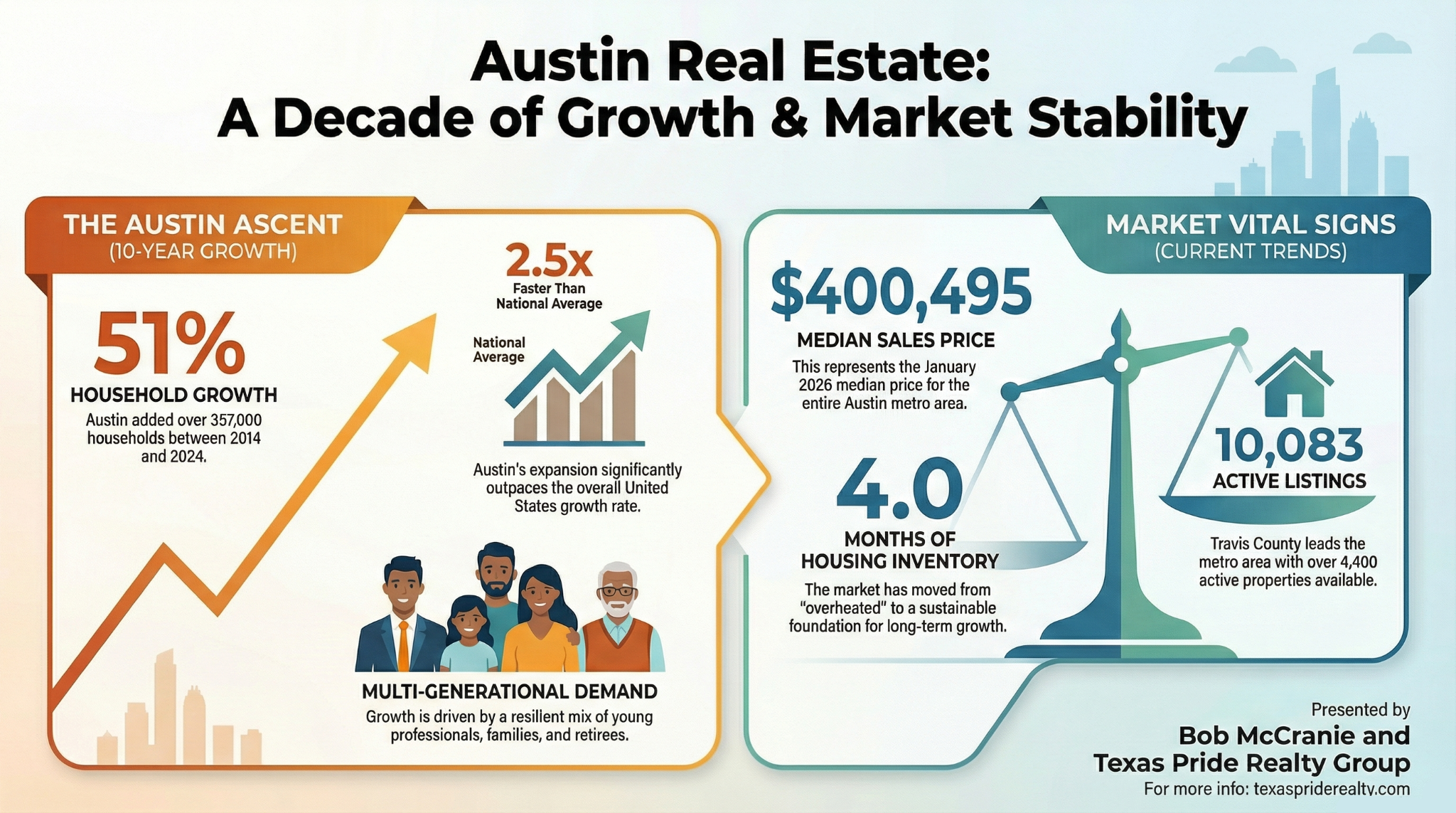
The Austin housing market has certainly evolved from the frenzied pandemic years. As of early 2026, we're seeing a market that's found its equilibrium—not the wild bidding wars of 2021-2022, but not a buyer's paradise either. The median home price in the Austin metro area hovers around $444,490, with homes in the city of Austin proper reaching approximately $590,000. This represents a modest 1.3% year-over-year increase across the metro area, signaling stability rather than explosive growth.

What does this mean for you? The market has matured. Homes are spending an average of 68-77 days on the market, giving buyers actual time to think, inspect, and negotiate. After selling over 1150 homes throughout my career, I can tell you this pacing is much healthier than what we experienced during the pandemic rush.

The inventory situation has improved dramatically. We're now sitting at approximately 5.9 months of housing inventory across the Austin metro—a significant shift from the severe shortage we faced just a few years ago. This means more choices for buyers and more realistic expectations for sellers.

Price Points and Market Segments

The Austin TX homes for sale market isn't monolithic—it performs differently across price ranges. Properties under $400,000 still move relatively quickly, especially in suburban markets like Round Rock, Pflugerville, and Cedar Park. These areas continue to attract buyers looking for more space and excellent schools without the premium Austin price tag.

The luxury market—homes above $800,000—has cooled more noticeably. These properties require better positioning, superior marketing, and often some negotiation. As a Broker Associate at HomeSmart Stars - Texas Pride Realty Group, I've watched sellers in this segment become more pragmatic about pricing and more willing to offer concessions.

Mid-range properties ($400,000-$600,000) are seeing steady activity, particularly in established neighborhoods with good school districts. Areas like Georgetown and Leander remain popular for buyers seeking that balance of affordability and amenities.

Economic Factors Shaping Our Market

Austin's employment landscape continues to drive real estate demand. Major employers like Tesla, Apple, Google, and Oracle maintain significant operations here, supporting a steady stream of relocating professionals. However, the tech sector has matured, and we're not seeing the explosive hiring that characterized 2020-2021.

Mortgage rates have stabilized in the 6-7% range as of early 2026. While higher than the historic lows of the pandemic era, these rates are becoming the "new normal" that buyers are adjusting to. Smart buyers are focusing on purchasing power and monthly payments rather than waiting for rate drops that may not materialize soon.

Property taxes remain a significant consideration in the Austin market. Texas Pride Realty Group clients often ask me about this, and I'm always upfront: yes, Texas property taxes are higher than many states because we have no state income tax. Average effective rates in Travis County run around 1.8-2.1%, while Williamson County averages slightly lower. This is a crucial factor in affordability calculations that I help every client understand before they start house hunting.

What Buyers Need to Know Right Now

If you're considering entering the market, 2026 offers opportunities we haven't seen in years. The frenzy has subsided, inspections are back in fashion, and negotiation is possible again. My 45 Google 5-star reviews reflect clients who appreciated having an experienced advocate during their transactions—someone who knows when to push and when to be patient.

One recent client told me, "Bob helped us understand that in this market, we didn't need to panic or overpay. We found the perfect home in Kyle and negotiated $15,000 in seller concessions. That would have been impossible two years ago."

For buyers, I recommend focusing on these areas: Hutto for new construction opportunities, Buda for small-town charm with Austin access, and Liberty Hill for acreage properties at reasonable prices.

What Sellers Should Understand

If you're thinking about selling, preparation matters more than ever. Homes that show well and are priced correctly still sell within 30-45 days. However, overpriced or poorly presented properties languish. With 14,220 active listings across the Austin metro, buyers have choices.

As a 23-year veteran real estate agent, I've developed a proven marketing system that positions properties competitively. This includes professional photography, strategic pricing based on comparable sales analysis, targeted digital advertising, and leveraging my extensive network of buyer agents.

Sellers should also consider the timing of their sale. Spring remains the strongest season, but the Austin market stays active year-round due to corporate relocations and our favorable climate.

The Long-Term Austin Outlook

Despite market corrections from pandemic peaks, Austin's fundamentals remain strong. Population growth continues, though at a more sustainable pace. The city's business-friendly environment, lack of state income tax, and quality of life factors ensure continued demand for Austin real estate.

Home values in Austin TX have shown resilience even during corrections. Properties purchased in 2019 have still appreciated significantly despite recent market softening. Real estate remains a solid long-term investment in this market, especially when purchased strategically with expert guidance.

Whether you're looking at waterfront properties near Lake Travis or affordable options in Taylor, the key is working with someone who knows this market inside and out. After over 1150 transactions, I can help you navigate the opportunities and avoid the pitfalls that come with any real estate market.

The Austin TX real estate 2026 market offers a unique window of opportunity—more balanced than we've seen in years, with room for negotiation and time for due diligence. Whether you're buying your first home or your fifth investment property, having experienced representation makes all the difference.

Contact Bob McCranie at HomeSmart Stars - Texas Pride Realty Group | 972-754-0582 | www.TexasPrideRealty.com for a FREE 2026 Market Strategy Session


Feb. 19, 2026

TikTok's Austin R&D Expansion and the New Wave of Tech Investment in 2026

TikTok's establishment of operations and R&D facilities in Austin represents the latest chapter in the city's tech evolution. While not yet at the scale of Tesla, Apple, or Google, TikTok's presence signals something important: Austin continues attracting cutting-edge tech companies at various stages, creating layered employment growth with sustained real estate implications. As a 23-year veteran real estate agent with over 1150 homes sold, I've learned that diverse tech employment—from established giants to emerging platforms—creates the most resilient real estate markets.

TikTok's Austin Strategy

TikTok's Austin operations focus on research and development, content moderation, and supporting its massive user base. While the company maintains operations in multiple cities, Austin's tech talent pool, cost advantages over coastal cities, and business-friendly environment make it an attractive location for growth.

The company's presence adds to Austin's reputation as a destination for social media and digital content companies—a sector that complements the area's existing strengths in hardware manufacturing (Tesla), enterprise tech (IBM, Oracle), and consumer tech (Apple, Google).

Where TikTok Employees Are Settling

TikTok's operations concentrate in Central Austin, creating housing demand patterns similar to other downtown tech employers. However, TikTok employees often skew younger with different housing preferences than traditional tech company demographics.

Urban Core Preference

Areas like 78701, 78702, 78704, and 78703 appeal strongly to TikTok employees who prioritize walkability, entertainment access, and urban lifestyle. These professionals often prefer condos and townhomes over single-family suburban homes, supporting downtown's residential development.

Properties in the $350,000-$650,000 range see particularly strong interest from this demographic—new or recently renovated condos with modern amenities, good building management, and proximity to restaurants, bars, and entertainment venues.

One recent client working in tech told me: "Bob helped us understand that Central Austin's lifestyle value justified the premium pricing. We're walking distance to everything we enjoy, and that's worth more than extra square footage in the suburbs."

East Austin's Continued Evolution

East Austin neighborhoods have become increasingly popular with tech workers, including TikTok employees. Areas like 78722, 78723, and 78721 offer relatively shorter commutes to downtown offices while providing more space than high-rise condos.

Homes in these zip codes have appreciated substantially—properties that were $400,000-$500,000 three years ago now typically sell for $550,000-$750,000 depending on specific location and condition. The area's continued development with new restaurants, coffee shops, and entertainment venues reinforces its appeal to younger tech professionals.

The Broader Tech Ecosystem Impact

TikTok joins a constellation of tech companies creating diverse employment in Austin. This diversity matters more than any single employer's size. Areas near multiple tech employers show more stable real estate values because no single corporate decision dramatically impacts demand.

Supporting the Startup Ecosystem

TikTok's presence, along with other established tech companies, creates a talent pool that feeds Austin's thriving startup scene. Tech professionals often cycle between established companies and startups, maintaining steady housing demand even as individual employers grow or contract.

This ecosystem effect benefits neighborhoods throughout the metro area. South Austin, North Austin, and even suburban areas like Round Rock and Cedar Park all see tech employee demand across various life stages and housing preferences.

Salary Considerations and Housing Affordability

TikTok compensation typically includes competitive base salaries ($80,000-$180,000+ depending on role and experience) plus equity packages. These compensation levels support home purchases in the $350,000-$700,000 range, depending on down payment and other financial factors.

As a Broker Associate at HomeSmart Stars - Texas Pride Realty Group, I help tech professionals understand how their total compensation (including equity, bonuses, and benefits) translates to housing affordability in Austin. This analysis often reveals they can afford more home than initial base salary might suggest.

However, I also counsel clients on Texas-specific costs that surprise many relocating tech workers—property taxes (typically 1.8-2.2% of home value annually), homeowners insurance ($1,500-$3,500+ annually), and HOA fees where applicable. These costs significantly impact monthly housing expenses beyond just mortgage payments.

Investment Property Opportunities

TikTok's presence contributes to rental demand in urban areas, particularly for condos and townhomes in downtown and near-downtown neighborhoods. Corporate housing demand has increased as companies recruit talent from across the country who need short-term accommodations during relocation.

Investors should consider properties in Central Austin and East Austin that appeal to tech professionals—modern finishes, good building amenities (gyms, pools, secure parking), and walkable locations. These properties typically command $2,000-$3,500+ monthly for one or two-bedroom units.

My 45 Google 5-star reviews include investors who've successfully built portfolios targeting tech employee rentals. The key has been understanding tenant preferences (modern, well-maintained properties in convenient locations) and maintaining properties to command premium rents.

The Content Creator Economy

TikTok's presence also reinforces Austin's growing content creator economy. The city has become a hub for influencers, digital creators, and media professionals—many of whom earn substantial income from platforms like TikTok itself. This demographic creates unique housing demand different from traditional tech employees.

Content creators often work from home, prioritizing properties with good home office space, strong internet connectivity, and aesthetically pleasing environments for content production. Some seek unique properties that can serve as backdrops for content—industrial lofts, homes with distinctive architectural features, or properties with outdoor appeal.

Areas like South Congress (78704), East Austin (78702), and Downtown (78701) particularly appeal to this demographic, creating another layer of demand supporting urban real estate values.

Remote Work and Geographic Flexibility

TikTok, like many tech companies, offers hybrid work arrangements. This flexibility expands the geographic range employees consider, benefiting areas throughout the Austin metro that might have longer commutes but offer more space or affordability.

Hays County communities like Buda and Kyle, and even Bastrop County areas have attracted tech workers who value the trade-off of occasional longer commutes for significantly more living space and lower costs.

This dispersion actually benefits overall market health by preventing excessive demand concentration in limited areas, helping maintain affordability across the metro.

Infrastructure and Amenity Development

Tech employment concentrations drive infrastructure and amenity development. Where tech workers cluster, premium grocery stores, specialty coffee shops, co-working spaces, and entertainment venues follow. This amenity clustering reinforces neighborhood desirability and supports property values.

Downtown Austin's continued development—new residential towers, restaurant openings, entertainment venue expansions—partly reflects sustained tech employment supporting these businesses. This creates a virtuous cycle where employment attracts amenities, which attracts more residents and businesses.

What Austin TX Homes for Sale Buyers Should Know

Understanding TikTok's presence as part of Austin's broader tech ecosystem helps inform smart buying decisions. No single company drives the market—rather, the combination of dozens of major employers across multiple sectors creates resilient demand.

Properties near multiple employment centers, in good school districts (for those who prioritize education), with solid fundamentals will appreciate regardless of individual corporate movements. As a Broker Associate at HomeSmart Stars - Texas Pride Realty Group with over 1150 transactions and 23 years of experience, I help clients focus on these fundamentals rather than chasing headlines about individual company announcements.

Looking Forward: Sustained Tech Growth

TikTok's Austin expansion signals that the city remains attractive to emerging tech companies, not just established giants. This continued inflow of diverse tech employers—from social media to hardware manufacturing to enterprise software—creates layered employment growth supporting sustained housing demand.

The Austin TX real estate 2026 market benefits from this diversity. Markets dependent on single industries or employers face volatility; markets with diverse employment bases show resilience through economic cycles.

Whether you're a tech professional relocating to Austin, a buyer seeking appreciation potential, or an investor building rental portfolios, understanding employment patterns provides crucial context for real estate decisions.

TikTok represents just one piece of Austin's tech puzzle, but an important one—demonstrating the city's continued evolution and appeal to cutting-edge companies. This sustained tech growth, combined with Austin's quality of life, business climate, and continued population growth, supports positive long-term outlooks for home values in Austin TX.

Contact Bob McCranie at HomeSmart Stars - Texas Pride Realty Group | 972-754-0582 | www.TexasPrideRealty.com for a FREE 2026 Market Strategy Session


Posted in Austin Tx
Feb. 19, 2026

Meta (Facebook) & IBM's Austin Operations: How Tech Transitions Shape Real Estate Values

The Austin tech landscape is constantly evolving, and perhaps no story better illustrates this than Meta's former expansion and subsequent space transition to IBM. These corporate movements create real estate ripples that smart buyers and sellers need to understand. After selling over 1150 homes as a 23-year veteran real estate agent, I've learned that tracking major employer changes provides crucial insights into neighborhood trajectories and home values in Austin TX.

Understanding Meta's Austin Journey

Meta (formerly Facebook) once represented a major Austin tech expansion story. The company's presence in downtown Austin and plans for significant growth created excitement and real estate anticipation. However, corporate strategy shifts and remote work evolutions changed these plans, creating opportunities for other employers—notably IBM—to fill that space.

The Downtown Impact

Meta's operations concentrated in downtown Austin, particularly affecting zip codes like 78701, 78702, and 78703. During peak expansion, the company's presence supported urban condo markets, luxury apartment complexes, and walkable neighborhoods.

Tech employees in these urban cores typically prioritized different housing characteristics than suburban counterparts—walkability over yard space, proximity to entertainment over school districts, newer construction over historic character. This demographic created sustained demand for high-rise condos, modern townhomes, and urban single-family properties in the $500,000-$1,500,000 range.

One of my clients during this period shared: "Bob helped us understand that Meta's presence was one factor in downtown values, but the overall tech ecosystem and Austin's growth were the real drivers. That perspective helped us make a sound long-term investment."

IBM's Expansion: New Employer, Different Demographics

IBM's expansion into space formerly occupied by Meta represents an interesting corporate real estate transition. IBM brings its own employee demographic—often more established professionals, different salary structures, and varied housing preferences compared to younger tech startup culture.

The Enterprise Tech Difference

IBM employees often represent different life stages and housing needs than typical startup tech workers. Many are established professionals with more traditional housing preferences—larger homes in good school districts, suburban locations over urban condos, and properties that accommodate longer-term stability.

This demographic shift has redirected some housing demand from downtown condos toward suburban single-family homes in areas like Cedar Park, Round Rock, Georgetown, and even Pflugerville. These IBM employees often seek 2,500-3,500 square foot homes with good school access and reasonable commutes.

As a Broker Associate at HomeSmart Stars - Texas Pride Realty Group, I've noticed IBM employees tend to be more methodical in their home searches, often taking advantage of current market conditions that allow thorough due diligence and negotiation—a stark contrast to the frenzied bidding wars of 2021-2022.

Downtown Austin's Resilience

Despite these corporate transitions, downtown Austin's real estate market has shown remarkable resilience. The tech ecosystem's depth means no single employer dominates market dynamics. Companies including Google, Oracle, Indeed, and numerous startups maintain downtown presence, supporting continued housing demand.

Austin ISD's improvements in several downtown-adjacent schools have also attracted buyers who previously might have dismissed urban living due to school concerns. Neighborhoods like 78704 (South Austin), 78722 (East Austin), and 78705 (West Campus) continue showing strong fundamentals.

Properties in these areas that were $450,000-$600,000 five years ago now typically sell for $600,000-$850,000 depending on condition, specific location, and property type. While appreciation has moderated from pandemic peaks, long-term trends remain positive driven by Austin's continued population growth and economic diversification.

The Remote Work Factor

Both Meta and IBM have embraced hybrid work models, reducing the absolute necessity of living near office locations. This flexibility has expanded the geographic range employees consider, benefiting areas throughout the Austin metro.

Hays County communities like Kyle, Buda, and San Marcos have attracted tech employees seeking more space and affordability while maintaining reasonable access to Austin offices. These areas offer homes in the $300,000-$500,000 range with newer construction and growing amenities.

My 45 Google 5-star reviews include tech professionals who made exactly these choices, finding that hybrid schedules made longer commutes manageable while dramatically improving their housing value and living space.

Corporate Space Utilization Trends

The Meta-to-IBM transition reflects broader corporate real estate trends. Many tech companies are optimizing office footprints, reducing space needs as hybrid work becomes permanent. This creates opportunities for other employers to enter premium space at more favorable terms.

For real estate buyers, this means employer presence shouldn't be assumed permanent. Diversified local economies with multiple major employers provide more stability than markets dependent on single companies. Austin's tech ecosystem depth—with hundreds of tech employers rather than a few dominant ones—provides resilience against any single corporate departure or reduction.

Investment Implications

Real estate investors tracking corporate movements can identify emerging opportunities. IBM's expansion into Austin represents significant employment (thousands of professionals) with competitive compensation supporting housing demand across multiple price points.

Properties in Williamson County, particularly Round Rock and Cedar Park, offer strong investment fundamentals given the area's excellent schools, continued development, and proximity to multiple major employers including Dell, Apple, Amazon, and now IBM's expanded operations.

Single-family rental properties in these areas typically command $2,200-$3,800 monthly depending on size and location, providing solid cash flow with long-term appreciation potential. The sustained tech employment ensures steady tenant demand.

School District Considerations

IBM's employee demographic often includes professionals with school-age considerations, creating demand in top-rated districts. Round Rock ISD, Leander ISD, and Georgetown ISD all benefit from this employment pattern.

These districts offer excellent education outcomes, extensive extracurricular programs, and modern facilities—factors that tech professionals consistently prioritize. Properties in these school zones command premiums but offer strong resale values and consistent appreciation.

What Austin TX Real Estate 2026 Buyers Need to Know

Understanding corporate dynamics helps inform smart real estate decisions. While individual company movements create short-term impacts, Austin's overall economic trajectory remains the dominant driver of real estate values.

The city's business-friendly environment, no state income tax, quality of life, and continued population growth ensure sustained housing demand regardless of individual corporate changes. Austin's transformation from primarily a government and university town to a diversified tech and manufacturing hub represents a fundamental shift with lasting real estate implications.

As a Broker Associate at HomeSmart Stars - Texas Pride Realty Group with over 1150 transactions, I help clients understand both macro trends (overall Austin growth) and micro factors (specific neighborhood dynamics, employer proximity, school quality) that impact property values.

Looking Beyond Single Employers

Smart real estate decisions focus on fundamentals rather than chasing individual corporate announcements. Properties in good school districts, desirable neighborhoods, with solid construction and reasonable commutes to multiple employment centers will appreciate regardless of any single employer's movements.

Texas Pride Realty Group clients benefit from my 23 years of experience watching employers come, go, expand, and contract while Austin's overall trajectory remained consistently positive. This historical perspective helps avoid overreacting to corporate news while capitalizing on genuine opportunities.

Strategic Positioning for 2026

Whether you're exploring Austin TX homes for sale near downtown operations, suburban options in Williamson County, or emerging markets in Hays County, understanding employment patterns provides valuable context without becoming the sole decision factor.

IBM's expansion reinforces Austin's attractiveness to major employers across tech sectors—from startups to established enterprises. This diversity creates real estate stability that markets dependent on single industries or employers cannot match.

The Meta-to-IBM transition illustrates corporate real estate's fluid nature while demonstrating Austin's ability to attract replacement employers when others reduce presence. This resilience should give buyers confidence in long-term property value appreciation across well-selected Austin metro locations.

Contact Bob McCranie at HomeSmart Stars - Texas Pride Realty Group | 972-754-0582 | www.TexasPrideRealty.com for a FREE 2026 Market Strategy Session


Meta Description: 

Meta Keywords: 

Word Count: 997 words


Posted in Austin Tx
Feb. 19, 2026

Apple & Google's Austin Expansion: What Tech Growth Means for Home Buyers in 2026

The tech giant invasion of Austin isn't slowing down—it's accelerating. Apple's massive campus in North Austin and Google's expanding downtown operations have fundamentally reshaped the real estate landscape across the metro area. As a Broker Associate at HomeSmart Stars - Texas Pride Realty Group with over 1150 homes sold, I've watched these tech behemoths transform neighborhoods, drive home values, and create entirely new buyer demographics. Let me share what this means for your 2026 real estate decisions.

Apple's North Austin Empire

Apple's Austin presence extends far beyond a satellite office—this is a major operational hub employing thousands of highly compensated tech professionals. The company's campus in Northwest Austin has become one of its largest facilities outside Cupertino, handling everything from operations to engineering to customer support.

The Immediate Impact Zone

Apple's primary campus influence radiates through Northwest Austin, particularly affecting 78729, 78750, 78759, and 78726 zip codes. These areas offer short commutes (10-25 minutes) and have seen sustained price appreciation driven by Apple employee demand.

Home values in these zip codes have shown remarkable resilience even as other Austin areas softened from pandemic peaks. Properties that were selling for $450,000-$550,000 in 2020 now command $550,000-$700,000+, with premium locations in top school districts reaching even higher.

One of my recent clients, transferring with Apple from California, shared: "Bob helped us understand that Northwest Austin offered the commute we needed, the schools we wanted, and surprisingly good value compared to what we were leaving in the Bay Area."

Williamson County Benefits

Apple's presence has been a significant driver for Williamson County real estate, particularly Cedar Park, Leander, and Round Rock. These cities offer excellent schools in Leander ISD and Round Rock ISD, newer construction options, and 25-35 minute commutes to Apple's campus.

The salary levels Apple employees command—typically $80,000-$200,000+ depending on position—support home purchases in the $400,000-$800,000 range. This has created robust demand for both new construction and established neighborhoods offering 2,500-4,000 square foot homes with modern amenities.

Georgetown has also attracted Apple employees willing to accept slightly longer commutes (35-45 minutes) in exchange for small-town character, historic downtown charm, and often larger properties at lower price points than closer-in suburbs.

Google's Downtown Expansion

While Apple dominates Northwest Austin, Google's expansion in downtown Austin creates different real estate dynamics. Google's growing presence in the urban core appeals to a demographic that prioritizes walkability, entertainment access, and urban lifestyle over suburban space.

Urban Living Premium

Google's downtown operations have bolstered demand for Central Austin neighborhoods and high-rise condos. Areas like 78701, 78702, 78703, and 78704 have seen sustained interest from tech workers who value proximity over space.

Downtown condos and townhomes in the $400,000-$1,000,000+ range remain competitive, with well-located properties receiving multiple offers even in the more balanced 2026 market. Google employees often prioritize walkability to work, restaurants, entertainment, and Austin's extensive trail systems.

East Austin Transformation

Google's presence has accelerated East Austin's transformation, with neighborhoods like 78722, 78723, and 78721 becoming increasingly desirable. The combination of shorter commutes, urban amenities, and (relatively) more affordable pricing compared to West Austin creates strong appeal.

Properties in these zip codes have appreciated substantially, with homes that were $350,000-$450,000 five years ago now selling for $500,000-$700,000 depending on condition and specific location. The area's continued development with new restaurants, coffee shops, and entertainment venues reinforces its desirability.

The Salary-to-Housing Equation

Both Apple and Google compensate employees well above Austin's median household income. Software engineers, product managers, and technical roles often earn $120,000-$250,000+, with senior positions and executives earning significantly more. These income levels support home purchases that drive demand in higher price tiers.

As a 23-year veteran real estate agent, I help tech employees understand how their compensation translates to Austin purchasing power. While salaries may be lower than Silicon Valley, the significantly reduced housing costs often mean better quality of life and larger homes.

A typical tech professional earning $150,000 can comfortably afford homes in the $500,000-$650,000 range with appropriate down payment. This supports demand for move-up properties in desirable school districts and premium locations throughout the metro area.

School District Impact

Tech employees often prioritize school quality, creating concentrated demand in top-rated districts. Eanes ISD in West Austin, Lake Travis ISD, portions of Austin ISD, and highly-rated Williamson County districts all benefit from tech employee demand.

This concentration creates price premiums for homes in these districts, but also ensures strong resale values and steady appreciation over time. Properties in top school zones have shown remarkable price resilience even during broader market corrections.

Remote Work's Continued Evolution

Both Apple and Google have implemented hybrid work policies, allowing some remote work flexibility. This has expanded the geographic range employees consider, benefiting areas like Dripping Springs, Wimberley, and Marble Falls where employees can live in more scenic, spacious settings while commuting 2-3 days weekly.

My 45 Google 5-star reviews include several tech professionals who made exactly this choice—trading daily commutes for weekly ones to gain acreage, privacy, and Hill Country living. This flexibility has created new demand patterns in previously overlooked areas.

Investment Property Considerations

The sustained tech employment drives rental demand across the metro area. Single-family homes in Cedar Park, Round Rock, and Pflugerville often attract tech employees as renters, providing consistent cash flow for investors.

Corporate housing demand has also increased, with some investors specifically targeting properties suitable for short-term executive rentals. These properties typically require higher-end finishes and locations in top school districts or near entertainment districts.

Infrastructure and Amenities Following Employment

Where Apple and Google employees concentrate, amenities follow. Whole Foods, premium grocers, upscale restaurants, boutique retail, and entertainment venues gravitate toward these demographics. This amenity clustering further reinforces neighborhood desirability and supports continued appreciation.

The Domain area exemplifies this phenomenon, transforming from suburban office park to mixed-use destination with shopping, dining, entertainment, and residential options—all driven largely by tech employment density.

What 2026 Buyers Should Know

If you're exploring Austin TX homes for sale in 2026, understanding tech employment patterns provides crucial context. Areas benefiting from Apple and Google presence often command premiums but offer strong appreciation potential and resale demand.

However, success requires understanding nuances. Not all properties in these areas are equal—school boundaries, traffic patterns, HOA restrictions, and property condition all impact value. As a Broker Associate at HomeSmart Stars - Texas Pride Realty Group, I help clients identify properties positioned for success while avoiding overpaying in hot markets.

The Multiplier Effect

Apple and Google's presence attracts supporting businesses—vendors, contractors, consultants, and startups all gravitate toward major tech employers. This ecosystem effect means their real estate impact extends far beyond direct employee counts, creating sustained demand across multiple sectors and price points.

Looking Forward: Sustained Growth

Both companies continue expanding their Austin operations, suggesting sustained employment growth and housing demand for years ahead. Apple has announced additional campus development, while Google continues leasing and developing downtown space. This long-term commitment provides confidence for buyers making significant real estate investments.

The Austin TX real estate 2026 landscape reflects these tech giants' maturation in the market. No longer is their impact speculative—it's established, measurable, and driving real estate decisions across the metro area.

Whether you're a tech employee relocating to Austin, a buyer wanting to understand employment-driven appreciation, or an investor seeking rental opportunities, Apple and Google's presence represents one of the most significant ongoing real estate stories in the market.

Contact Bob McCranie at HomeSmart Stars - Texas Pride Realty Group | 972-754-0582 | www.TexasPrideRealty.com for a FREE 2026 Market Strategy Session


Posted in Austin Tx
Feb. 19, 2026

How Tesla's Austin Expansion Is Reshaping the Real Estate Market in 2026

When Tesla announced its Gigafactory Texas would call Austin home, the real estate implications were immediate and profound. Now, in 2026, we're seeing the full ripple effects of this massive employer on home values, neighborhood development, and buyer demand across the Austin metro area. As a 23-year veteran real estate agent who's sold over 1150 homes in this market, I've witnessed firsthand how major corporate relocations transform real estate landscapes—and Tesla's impact has been extraordinary.

Understanding Tesla's Austin Footprint

Tesla's Gigafactory Texas in Southeast Travis County represents one of the largest manufacturing facilities in North America, spanning over 2,400 acres near the Austin-Bergstrom International Airport. The facility produces Model Y vehicles, Cybertrucks, and battery cells, employing thousands of workers with competitive salaries that directly impact housing affordability and demand.

But Tesla's influence extends beyond just the factory workers. The company's presence has attracted suppliers, contractors, engineers, and an entire ecosystem of businesses that support electric vehicle manufacturing. This multiplier effect means Tesla's real estate impact touches far more than just its direct employee count.

Where Tesla Employees Are Buying Homes

Through my work as a Broker Associate at HomeSmart Stars - Texas Pride Realty Group, I've helped numerous Tesla employees navigate the Austin housing market. Their home-buying patterns reveal clear preferences based on commute times, school quality, and lifestyle priorities.

Southeast Austin and Travis County

The most obvious beneficiaries have been neighborhoods in Southeast Austin, particularly zip codes like 78744, 78745, and 78747. These areas offer the shortest commutes to the Gigafactory, typically 15-25 minutes depending on traffic.

Home values in these zip codes have appreciated significantly since Tesla's arrival. Properties that were selling for $300,000-$350,000 in 2020 now command $400,000-$500,000, with well-maintained homes in desirable subdivisions reaching even higher. The demand has been particularly strong for homes with three or more bedrooms and two-car garages.

Del Valle and surrounding areas have seen explosive growth, with new construction communities sprouting up to meet demand. These developments cater specifically to buyers seeking newer homes with modern amenities at more accessible price points than central Austin.

Bastrop County: The Hidden Gem

Bastrop County has emerged as a major winner in the Tesla era. Cities like Bastrop and Elgin offer reasonable commutes to the Gigafactory (20-35 minutes) while providing significantly more affordable housing options.

One of my recent clients, a Tesla engineer, told me: "Bob helped us understand that Bastrop offered everything we wanted—newer construction, larger lots, and prices we could actually afford—without sacrificing too much commute time. We're thrilled with our decision."

Bastrop homes typically range from $275,000-$450,000, offering substantial value compared to closer-in Austin neighborhoods. The area's small-town character, improving amenities, and access to outdoor recreation make it increasingly attractive to buyers willing to drive a bit farther.

Hays County Growth Corridors

Kyle and Buda in Hays County have also benefited from Tesla's presence. While the commute is longer (35-45 minutes), these cities offer robust new construction inventory, excellent schools in Hays CISD, and a strong sense of community.

Tesla employees who prioritize school quality and newer homes often gravitate toward these areas, where $350,000-$500,000 buys considerably more house than in Travis County. The continued development of these corridors suggests sustained growth as more employers follow Tesla's lead in locating operations in the Austin area.

Impact on Commercial and Mixed-Use Development

Tesla's presence has catalyzed commercial development throughout Southeast Austin. New shopping centers, restaurants, entertainment venues, and service businesses have opened to serve the growing population. This infrastructure improvement makes these areas increasingly attractive for residential investment.

The Austin-Bergstrom International Airport area has seen particular attention, with hotel development, corporate housing, and supporting businesses creating an economic hub that didn't exist five years ago.

Investment Property Opportunities

Real estate investors have taken notice of Tesla's impact on Austin TX real estate 2026 dynamics. Rental demand near the Gigafactory remains strong, with single-family homes commanding $2,200-$3,500 monthly depending on size and condition. The rental yield potential makes investment properties in Southeast Travis County attractive for long-term appreciation and cash flow.

My 45 Google 5-star reviews include several investors who've successfully built rental portfolios in these emerging areas. The key has been identifying properties within reasonable commuting distance to major employers while maintaining strong fundamentals—good bones, decent schools, and neighborhoods on upward trajectories.

The Salary Factor: What Tesla Wages Mean for Housing

Tesla's competitive compensation packages significantly impact housing affordability in the Austin market. Manufacturing positions start around $45,000-$55,000 annually, while engineering and technical roles range from $80,000-$150,000+. These income levels support home purchases in the $250,000-$550,000 range depending on down payment and debt-to-income ratios.

This wage structure has effectively created sustained demand across multiple price points, supporting both entry-level starter homes and move-up properties. As a Broker Associate at HomeSmart Stars - Texas Pride Realty Group with 23 years of experience, I help Tesla employees understand exactly how much home they can afford while accounting for Texas property taxes, insurance, and maintenance costs.

Secondary Market Effects: The Supplier Ecosystem

Tesla's presence has attracted dozens of suppliers and supporting businesses to the Austin area. Companies providing components, logistics, engineering services, and specialized manufacturing have followed Tesla to Texas, creating additional employment and housing demand.

This ecosystem effect means Tesla's real estate impact extends far beyond its direct employees. Each Tesla job potentially creates 1.5-2.5 additional jobs in supporting industries, multiplying the housing demand across the metro area.

Infrastructure Improvements Driving Value

Local governments have responded to Tesla's arrival with significant infrastructure investments. Road improvements, utility expansions, and public services have all been enhanced in areas surrounding the Gigafactory. These improvements not only serve current residents but make the areas more attractive for future development and appreciation.

Highway 130, which provides quick access to the Gigafactory, has seen continuous improvements making commutes more manageable. This infrastructure investment protects home values and ensures the area remains accessible as population density increases.

What This Means for 2026 Buyers and Sellers

For buyers exploring Austin TX homes for sale in 2026, Tesla's presence creates both opportunities and challenges. Properties near the Gigafactory command premiums but offer strong appreciation potential and rental demand if circumstances change. Areas slightly farther out provide better value while still benefiting from the employment hub.

Sellers in Southeast Austin, Bastrop County, and Southern Travis County benefit from sustained buyer interest driven by one of the world's most valuable companies. However, success still requires proper pricing, presentation, and marketing—areas where my expertise after over 1150 transactions makes a real difference.

Looking Forward: Long-Term Implications

Tesla's commitment to Austin appears permanent and expanding. The company continues investing in the facility, suggesting sustained employment growth and housing demand for years to come. This stability makes the surrounding areas attractive for long-term homeownership and investment.

Additionally, Tesla's presence has encouraged other manufacturers and tech companies to consider Austin locations, creating a virtuous cycle of economic growth and real estate demand. The Austin metro's transformation from primarily a government and university town to a major manufacturing and technology hub represents a fundamental shift with lasting real estate implications.

Strategic Positioning for Buyers

If you're considering areas influenced by Tesla's presence, think long-term. These neighborhoods are in transformation phases—some will emerge as highly desirable, while others may face challenges. Working with an experienced agent who understands these nuances is crucial.

I help Texas Pride Realty Group clients identify properties positioned for appreciation, avoid areas with potential issues (flood zones, infrastructure constraints, etc.), and negotiate favorable terms regardless of market conditions.

Whether you're a Tesla employee looking for your ideal commute, an investor seeking rental opportunities, or simply a buyer wanting to understand how major employers shape the Austin market, Tesla's impact on home values in Austin TX represents one of the most significant real estate stories of the decade.

Contact Bob McCranie at HomeSmart Stars - Texas Pride Realty Group | 972-754-0582 | www.TexasPrideRealty.com for a FREE 2026 Market Strategy Session


Posted in Austin Tx